Bedding · Materials & Care
Organic Cotton Accents: What to Check in Coyuchi Bedding
A pillow cover can change the mood of a bed with less effort than a new duvet and less commitment than repainting a room. But the quiet promise of “organic cotton” is only one part of the story. Certification, weave, closure, dimensions, and care instructions determine whether an accent will work in daily life as well as in the imagination.
Published November 14, 2026
There is a particular kind of domestic optimism involved in buying a new pillow cover. One imagines a room made more considered by a small square of fabric: the bed less anonymous, the sofa more inviting, the whole interior brought into focus by a surface that may be only a few inches across. The reality is more practical. A cover has to fit an insert, tolerate the habits of its household, and survive the washing instructions printed on its label. Its virtues are tactile, but also technical.
That is especially true when the fabric is described as organic cotton. The phrase sounds reassuring and, in many cases, points toward meaningful standards of fiber production. Yet the words alone do not tell you which certification applies, how the cloth was woven, how it closes, whether it arrives with an insert, or whether it can be laundered at home. In bedding, the smallest details are often the ones that decide whether an object becomes a favorite or remains carefully arranged and rarely touched.
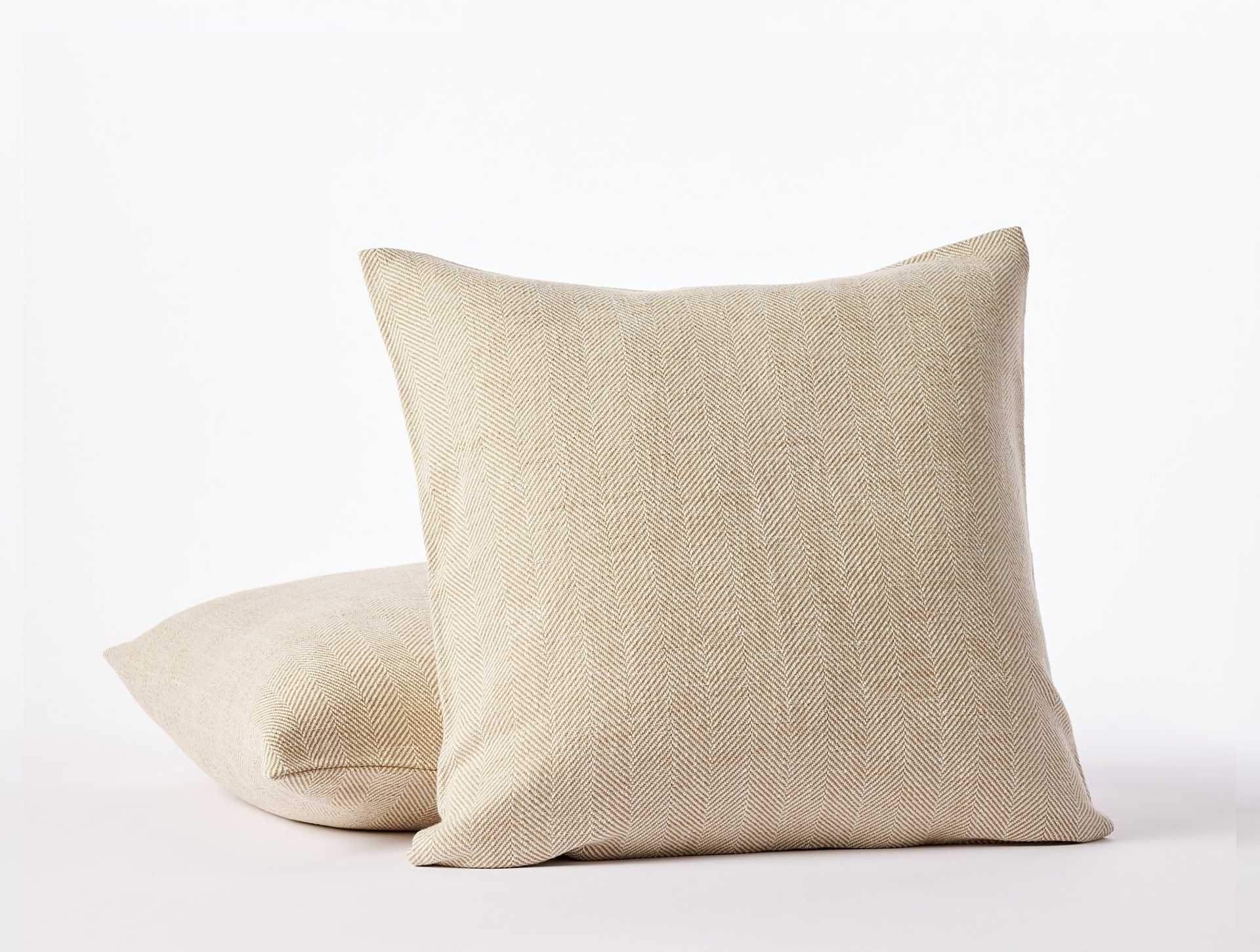
Coyuchi bedding offers a useful point of reference for thinking through these questions. A product listing for the Canyon Organic Decorative Pillow Cover, for example, specifies 100% organic cotton, a textured herringbone weave, GOTS certification, a knife-edge finish, and a back envelope closure. It also gives care guidance and makes clear that the insert is sold separately. Each statement answers a different question. Taken together, they provide a more useful account of the cover than the material name alone.
Start with the fiber claim, then look for its context
“Cotton” identifies a fiber. “Organic cotton” adds a claim about how that fiber was grown, but the scope and verification of that claim depend on the standards named by the maker. A shopper assessing an organic cotton cover should look for a specific certification or other clear explanation, rather than treating the adjective as a complete description of the product’s environmental or social performance.
In the Canyon cover’s case, the listing identifies the fabric as 100% organic cotton and states that it is GOTS certified. GOTS, or the Global Organic Textile Standard, is a textile certification with requirements that extend beyond a bare fiber label. The presence of a named standard gives the buyer something concrete to investigate and distinguish from a broad, unqualified marketing phrase. Certification is not a reason to stop asking questions; it is a better place to begin them.
It is also worth reading the language precisely. A description may refer to certified fabric, a certified product, or a factory holding a certification. Those statements are not necessarily interchangeable. Look for the exact scope represented in the product information, and consult the certifier’s own materials if you want to understand what a particular claim covers. The careful reader does not need to become an auditor, but should know that “organic” is not a universal guarantee about every stage of manufacturing.
Origin information can add another piece of the picture. The Canyon listing says the cotton is grown and woven in India. That tells you something about the stated production geography, though it does not by itself explain every stage of the supply chain. The most useful descriptions are those that make claims specific enough to assess without suggesting that one label answers every question about sourcing, labor, or impact.
A weave is not merely a pattern
Once the fiber has been established, the surface deserves attention. Two covers made from cotton can feel quite different because of yarn, weave, finishing, and construction. A smooth plain weave, a crisp percale, a lustrous sateen, and a raised herringbone do not behave identically under a hand or in a room. They catch light differently; they produce different degrees of visual movement; and they may call for different expectations about softness and upkeep.
The Canyon cover’s herringbone weave is described as textural and substantial, with a clean, minimalist silhouette. Herringbone is a woven pattern formed by short diagonal lines that reverse direction, creating a broken zigzag effect. On a decorative cover, the pattern can give a restrained color more presence without relying on a printed motif. Texture does part of the decorative work: it adds shadow and variation when the palette is quiet.
That quality can be useful in a room already full of patterns, where another floral or stripe might compete for attention. It can also make a simple bed feel more layered. The important question is not whether texture is universally better than print, but whether the surface has a role in the arrangement. A pronounced weave may read as a focal accent beside smooth sheets; beside a heavily quilted coverlet, it may become one more texture in a crowded conversation.
Descriptions such as “soft,” “substantial,” or “textural” are helpful as impressions, not measurements. They cannot tell you exactly how a fabric will feel in your own room, under your own light, or after repeated laundering. When a listing supplies construction details, use them to build a more grounded expectation. If it does not specify weight, thread count, or other technical particulars, do not infer those figures from an adjective.
Construction details have a practical life
The finish at the edge of a pillow cover is easy to overlook in a product photograph, but it helps determine the object’s character. The Canyon cover has a knife-edge finish: the seams meet in a straightforward edge without an added flange or decorative border. The result is a neat outline suited to an uncluttered look. By contrast, a flange can give a cover a framed, more formal appearance; piping creates a corded line; fringe adds movement and informality.
None of these finishes is inherently more durable or more sophisticated. Each changes the visual emphasis and may affect how the piece sits among other bedding. A knife edge tends to keep attention on the fabric itself. A border can make a pale cover read more distinctly against a pale duvet. A piped edge may echo the trim on a quilt or sham. The decision is less about rules than about proportion: the edge should complement the scale and finish of the surrounding pieces.
Closure matters, too. An envelope closure uses overlapping fabric panels at the back of the cover. It avoids a visible fastener and allows an insert to be removed without operating a zipper. The Canyon cover has this type of back closure. That makes the design visually quiet, while keeping the cover removable for cleaning. A zipper, whether exposed or discreet, can offer a secure closure and a tailored appearance, but its location and finish are worth checking before purchase.
There is no single closure that suits every household. For a frequently handled sofa pillow, ease of removal and a snug fit may matter most. For a bed accent that is mostly arranged in the morning and left alone, the appearance of the back closure may be a minor concern. In either case, construction language helps you understand what you are buying rather than leaving the mechanism to an afterthought.
The insert is a separate decision
One of the most useful details in a pillow-cover listing can also be the easiest to miss: whether the insert is included. The Canyon cover is sold as one pillow cover, with the insert sold separately. That distinction affects both budget and fit. A cover without an insert is not an incomplete product; it is an invitation to use an insert already on hand or select one independently. But it does require a second decision, and sometimes a second purchase.
Check the cover’s dimensions and compare them with the insert you intend to use. A cover that is too large for its insert may look slack, while an insert that is substantially oversized can strain seams or make the corners difficult to fill neatly. Some people prefer a fuller appearance and choose an insert slightly larger than the cover, but the ideal relationship depends on the fabric, the insert’s resilience, and the look desired. Do not assume the named size describes an included pillow or guarantees a particular level of fullness.
Dimensions also affect the way an accent works in a room. A square cover can anchor a bed arrangement; a narrower rectangular one may suit the front of a layered grouping or the curve of a sofa. A decorative pillow is not necessarily designed for overnight support, and a cover’s size alone says little about the firmness of the insert. If the pillow will be used for reading or lounging, consider the fill and the intended function separately from the cover fabric.
It is sensible to check the product page for the exact size before ordering. A photograph can make a cover seem larger or smaller than it is, and styling images may show multiple pillows or inserts that are not part of the item being sold. The written contents list is the decisive guide: cover only, insert included, or another configuration.
Care instructions are part of the design
Care is not an administrative footnote appended after the interesting information. It is one of the conditions under which the fabric will continue to look and feel the way its maker intended. The Canyon cover’s stated guidance is machine washing in cold water on a gentle cycle with like colors, followed by low tumble drying; a warm iron may be used if needed. Those instructions are more useful than a vague assurance that a cover is “easy care.”
Before the first wash, read the label attached to the actual item. Product pages can be updated, and care guidance may vary across fabrics, colors, trims, and production runs. If the label differs from a general description, follow the garment label or contact the maker for clarification. Cold water and a gentle cycle are common ways to reduce stress on textiles, but they should not be treated as universal instructions for every pillow cover.
Washing with like colors helps limit the risk of color transfer, particularly when a new textile is entering a load with pale bedding. A gentle detergent and prompt removal from the dryer can help reduce unnecessary abrasion and creasing. If a cover has embroidery, embellishment, wool, silk, or another sensitive component, its specific instructions take precedence over a general cotton routine. The presence of an organic fiber does not, on its own, determine how the finished fabric should be washed.
Drying deserves the same attention. High heat can be hard on many textiles and may contribute to shrinkage or wear; the Canyon listing specifies low heat. If a household prefers to air-dry, that may be worth considering, but the product’s stated directions should remain the first reference. Ironing is optional in the listing, not a requirement. A textured weave may be chosen precisely because a perfectly pressed surface is not the point.
Care instructions also reveal how a product fits into a household’s routine. Someone who wants to refresh pillow covers frequently may prioritize a straightforward machine-washable design. Someone with a carefully arranged guest room may be comfortable with more involved maintenance. Neither preference is more virtuous. The practical question is whether the likely care routine is one you can realistically maintain.
Coordinate without turning the bed into a catalogue
Organic cotton accents work best when they are considered as part of a room rather than as isolated objects. A herringbone cover can relate to a woven blanket, a wood floor, or the grain of a bedside table without matching any of them exactly. The point of coordination is not to repeat a color or motif until the room feels assembled from a single set. It is to create a few quiet correspondences: a repeated tone, a contrast of smooth and rough, or a shift from large-scale pattern to small-scale texture.
Begin with the largest surfaces. Sheets, duvet covers, blankets, and upholstery establish the room’s broad palette. A decorative cover can either continue that palette or introduce a controlled interruption. In a mostly white arrangement, a natural cotton texture may add depth without a strong color contrast. In a room already rich in warm neutrals, the same cover might support the existing tones rather than stand apart from them.
Scale is as important as color. A small herringbone may appear almost solid from across the room, while a bold stripe remains legible at a distance. If a bed has a large, expressive quilt, a quieter accent can provide a pause. If the bedding is plain, a textured or patterned cover can take on more responsibility. There is no need for every pillow to perform. A successful arrangement often includes a simple element that allows the more distinctive pieces to be noticed.
Think about use as well as appearance. Decorative pillows are often removed at night, stacked on a chair, or moved from bed to sofa. Covers that can be taken off easily offer flexibility for washing and seasonal changes. An accent that is beautiful but inconvenient to manage may become less attractive over time, particularly in a household where bedding is used rather than preserved for display.
A measured checklist for shopping
When evaluating organic decorative pillows or covers, the following questions make product descriptions easier to compare:
- What is the fiber? Look for an explicit material statement, such as 100% organic cotton, rather than relying on a broad “natural” description.
- What supports the claim? Note any named certification and the precise wording used to describe what is certified.
- How is the fabric constructed? Identify the weave, texture, quilting, printing, or other stated surface treatment.
- How is the cover finished? Check the edge treatment and whether the closure is an envelope, zipper, or another design.
- What comes in the package? Confirm dimensions and whether the listing includes a cover only or a complete pillow with an insert.
- How should it be cared for? Compare washing temperature, cycle, drying method, and ironing guidance with your usual routine.
- Where was it made? Treat origin as useful context, while recognizing that it is not a complete account of the supply chain.
- Will it suit the room? Consider scale, color, texture, and whether the pillow is meant for decoration, support, or both.
This checklist is not a test of whether a product is good or bad. It is a way to turn a persuasive description into usable information. A cover may be exactly right even if it has a simple construction and few claims. Another may offer extensive sourcing detail but demand a care routine that does not suit the household. The best choice is the one whose actual attributes align with the way the space is arranged and lived in.
The appeal of a small, well-understood object
The promise of organic cotton is strongest when it is treated neither as a magic phrase nor as a decorative flourish. It is one element in a chain of decisions involving fiber, construction, finish, care, and use. A GOTS-certified cotton cover with a textured herringbone weave can offer a tactile accent and a clearly stated material identity; its back envelope closure makes the cover removable, and its care instructions describe a manageable washing routine. Those specifics matter more than an adjective in isolation.
In the end, the most satisfying bedding choices are often modest in their claims. They tell you what the fabric is, how it is made, what is included, and how to look after it. They leave room for the object itself: the weave under a hand, the way a color settles against the sheets, the pleasing geometry of a pillow returned to its place. The room may not be transformed. It may simply become more legible to the people who live in it.
That is a respectable achievement for a square of cotton. It is also a reminder that good design does not ask us to stop looking at the details. It asks us to notice which details will matter after the parcel is opened, after the first wash, and long after the bed has been made.